Ravi GrowthGet Started
Claude
How to Use Claude to Research a Market and Competitors

Founders often decide on price, positioning and features with little evidence. Proper market research feels slow and expensive, so it gets skipped. AI can make the organising and thinking much faster. It cannot make the facts true. That distinction decides whether your research helps you or misleads you.
This guide shows a practical process. The rule that runs through every step: AI organises, and you verify with real sources.
What AI is good and bad at here
Good at: - Turning a vague idea into clear research questions. - Building comparison tables from information you give it. - Spotting gaps and patterns in notes you paste. - Suggesting what to look for and what to ask customers.
Bad at: - Knowing current prices, offers or news without live sources. Check what browsing or search features your plan offers, and treat their output as leads to confirm. - Giving reliable market-size numbers. Figures may be outdated or invented. - Knowing your local market.
Competitor facts must come from the competitor's own website, official filings, or direct observation, not from memory.
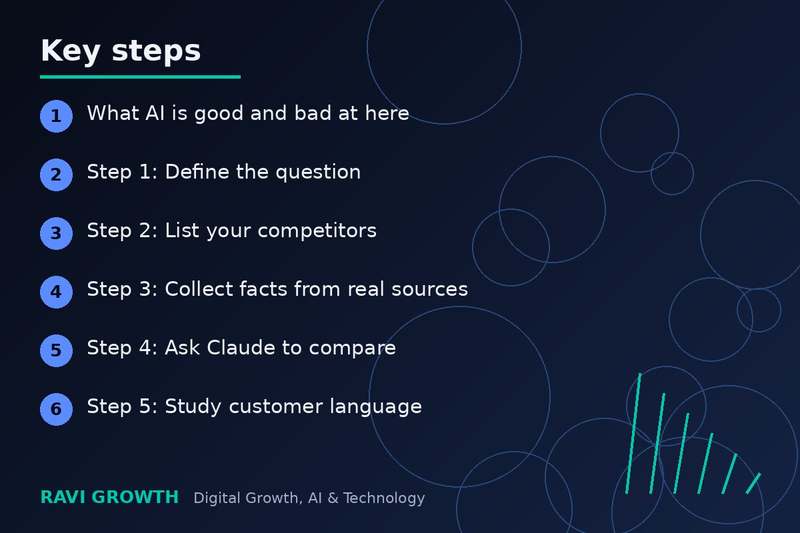
Step 1: Define the question
"Research my market" is too broad. Write one question that leads to a decision.
- "Should I price my service at ₹15,000 or ₹25,000 a month?"
- "What do the top five local gyms offer that we do not?"
- "Is there demand for a premium tier of my product?"
Prompt: I want to decide [decision]. Turn this into 5 specific research questions I can answer in one week, and list what evidence would answer each one.
A clear question keeps research from becoming endless reading.
Step 2: List your competitors
Include three types:
- Direct: same offer, same customer.
- Indirect: different offer, same problem (a free tool, a freelancer, a family member doing it).
- Aspirational: bigger or better-known players to learn from.
Find them by searching as your customer would. Note the top results, local map listings and ads. Ask real customers who else they considered.
Prompt: Here are the search terms my customers use: [list]. Suggest other types of competitors and substitutes I might be missing. Do not name specific companies unless you are certain they exist; otherwise describe the type.
Check every named company yourself.
Step 3: Collect facts from real sources
Create a sheet with one row per competitor. For each, visit their website and social pages and record:
- What they sell and for whom.
- Prices or price ranges, if public, with the date you checked.
- Offers and guarantees.
- Main promise on the home page.
- Reviews: average rating, count, and common praise and complaints.
- Strengths you can see, and gaps.
- Source link for each fact.
The source link and date are essential. Prices change.
Step 4: Ask Claude to compare
Paste your table, or your notes, and ask for analysis based only on that data.
Prompt: Below is my competitor research with sources. Use only this data. Create a comparison table of positioning, pricing and strengths. Then list: (1) where competitors are similar, (2) gaps nobody covers, (3) risks to my plan. If something is not in the data, write "not in data".
The instruction to use only your data prevents it from filling gaps with guesses.
Step 5: Study customer language
Reviews are the best free research. Paste a set of public review text (a few dozen lines, no personal details) and ask:
Prompt: From these reviews, list the top 10 things customers praise and the top 10 things they complain about. Group by theme. Quote short phrases customers use.
These phrases make strong website text, because they are the words real customers use.
Step 6: Form hypotheses, not conclusions
Turn findings into testable ideas.
Prompt: Based on this analysis, suggest 5 hypotheses about how I could position and price my offer. For each, say what I should test and how cheaply I could test it.
A hypothesis might be: "Customers will pay 20 percent more for a guaranteed reply within 2 hours." Test with a short survey, a pilot offer or a small ad.
Step 7: Verify before you decide
Before acting, check:
- Every competitor fact against the competitor's own site, with a date.
- Every number against its original source. If the source cannot be found, do not use it.
- Any claim about market size against a reputable published report, and read how it was measured.
- Recency. Anything older than a year may be stale.
- Sample size. Five reviews do not describe a market.
If Claude names a source, open it. If the page does not say what Claude said, discard the claim.
Step 8: Talk to customers
Desk research cannot replace asking people. Call or message five to ten customers or likely customers. Ask:
- What did you use before?
- What nearly stopped you from buying?
- What would make you switch?
- What would you pay for this?
Prompt: Write 8 neutral, open interview questions for customers of [business]. Avoid questions that lead them to a particular answer.
Paste your anonymised notes afterwards and ask for patterns.
Fair use and ethics
- Use public information only.
- Do not pose as a customer to extract private data.
- Do not copy competitors' content or images.
- Do not scrape sites in violation of their terms.
- Do not upload confidential documents belonging to others.
Mistakes to avoid
- Trusting invented statistics. Always find the source.
- No question. Research without a decision to make wastes time.
- Only desk research. Talk to real customers.
- No dates. Prices and offers expire.
- Copying the market leader. Look for the gap, not the crowd.
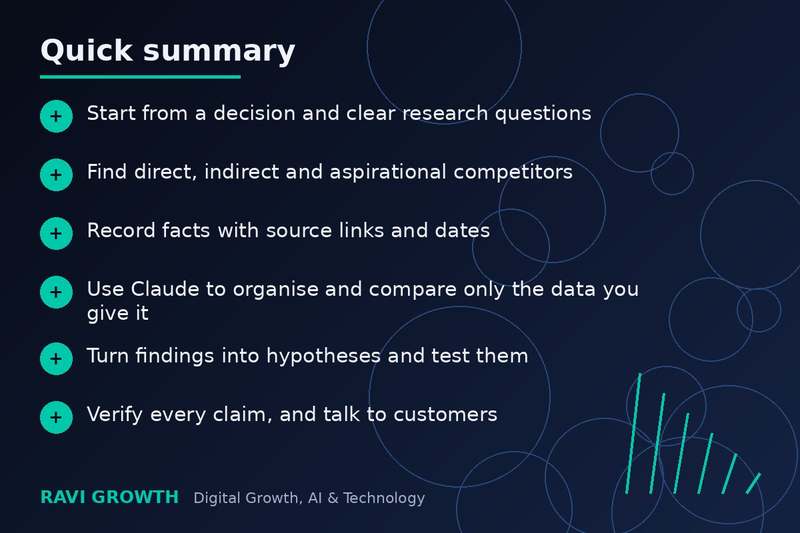
Quick summary
- Start from a decision and clear research questions.
- Find direct, indirect and aspirational competitors.
- Record facts with source links and dates.
- Use Claude to organise and compare only the data you give it.
- Turn findings into hypotheses and test them.
- Verify every claim, and talk to customers.
Frequently asked questions
Can Claude do market research alone? It can speed up organising and analysis, but you must supply and verify the facts.
Where do I find reliable data? Competitor sites, official government statistics, industry associations, published reports and customer conversations.
How long should research take? For a small decision, one focused week is usually enough.
What if I cannot find competitor prices? Record "not public", and consider mystery enquiries honestly, or ask customers what they paid.
Ravi Growth runs market and competitor reviews as part of its free growth audit. Ask for it through the Contact page.