Ravi GrowthGet Started
ChatGPT
ChatGPT Mistakes Business Owners Make (and How to Avoid Them)
ChatGPT is quick, polite and sure of itself. That is the danger. It can write a clean paragraph with a wrong price, a made-up law or a feature your product does not have, and nothing in the tone warns you. Business owners who get the most from it are not the ones who trust it most. They are the ones who know where it fails.
Here are the ten mistakes we see most, each with a fix.
1. Trusting facts without checking
What happens: ChatGPT produces a date, a figure, a rule or a name that sounds right and is wrong. This is often called a hallucination.
Fix: Treat every fact as unverified. For anything that matters (law, tax, prices, medical or safety information), check an official or primary source. Ask the tool for its source, then open the source yourself. If it cannot give a real link, assume the claim is unconfirmed.
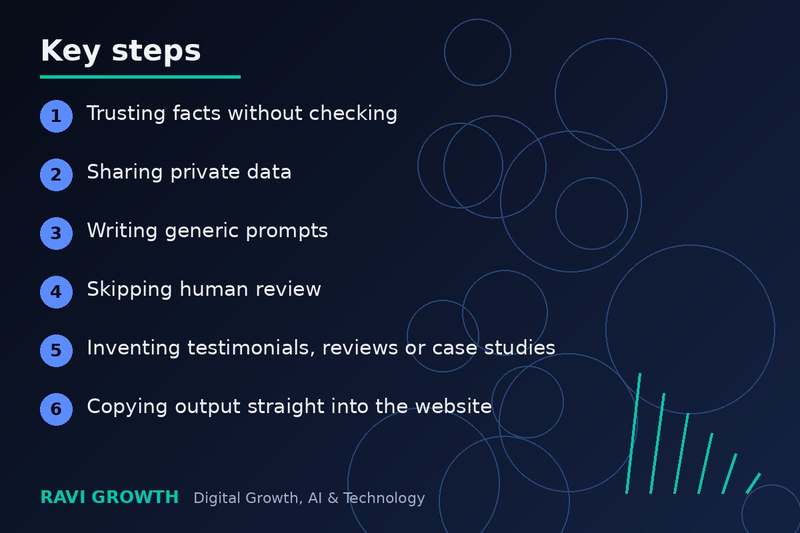
2. Sharing private data
What happens: An owner pastes a customer list, a contract or a bank statement to "summarise it quickly".
Fix: Remove names, numbers, addresses, financial details and anything confidential before pasting. Review your account's data settings. If a document is too sensitive to share, do not paste it. For business use, look at the plan options that offer stronger data controls, and read the current terms.
3. Writing generic prompts
What happens: "Write a post about my shop" produces a post any shop could have written.
Fix: Give context: who you are, who the customer is, the facts, the tone, the length. Use a role, task, context, format and example. Our guide on the five-part prompt formula shows how.
4. Skipping human review
What happens: Text goes straight from ChatGPT to the website, the customer or the bank.
Fix: Make a rule: nothing goes out unread. Name who checks it. For customer-facing text, one person reads it aloud, checks facts and fixes the tone. It takes two minutes.
5. Inventing testimonials, reviews or case studies
What happens: The tool is asked for "a customer review" and the owner posts it.
Fix: Never publish fake reviews, results or client names. It breaks platform rules, may break consumer-protection law and destroys trust when discovered. Collect real feedback. If you have no case studies yet, say "coming soon" or describe the service honestly.
6. Copying output straight into the website
What happens: Pages full of generic AI text. They read like thousands of others, offer nothing new and may rank poorly.
Fix: Use AI for outlines and first drafts. Then add what only you know: real photos, prices, local details, stories, numbers from your own work. Edit until a customer could tell it was written by someone who runs this business.
7. Using it for legal, tax or medical decisions
What happens: A founder asks ChatGPT if a contract clause is safe and signs on the answer.
Fix: Use it to understand terms and prepare questions. Then ask a qualified professional. The tool does not know your facts or current local law, and it is not accountable if it is wrong.
8. Expecting it to know recent events or your business
What happens: Asked about last month's rule change or your own price list, it guesses.
Fix: Give it the facts in the prompt. For current events, use a source with live data, and check the tool's current capabilities. Add the line: "If you do not know, say so. Do not guess."
9. Using one long chat for everything
What happens: Context from an old task leaks into a new one, or earlier details are forgotten.
Fix: Start a fresh chat for each separate job. Paste the facts you need again. Keep a note of your reusable context and brand voice.
10. Not measuring the benefit
What happens: The team "uses AI" but nobody knows if it saves time or improves anything.
Fix: Pick two tasks. Time them with and without ChatGPT for two weeks. Count corrections. Keep what saves time without lowering quality. Drop the rest.
A short review checklist
Before using AI-written content:
- [ ] Have I checked all facts, prices, dates and names?
- [ ] Is there any private data in the prompt or the output?
- [ ] Does it sound like us, not like everyone?
- [ ] Are there claims I cannot prove (best, number one, guaranteed)?
- [ ] Did a real person read it fully?
- [ ] Would I be comfortable if the customer knew AI helped?
If any box is unticked, it is not ready.
What good use looks like
A hotel owner uses ChatGPT to draft replies to online reviews. She gives it the hotel's policies and tone. She edits each reply and removes any promise she cannot keep. She never pastes guest names or booking numbers. Each reply takes two minutes instead of ten.
A consultant uses it to outline a proposal. He fills in the real numbers himself, checks every claim and rewrites the opening in his own voice.
In both cases the tool does the slow drafting. The person owns the facts and the final words.
Set a simple company policy
Even a one-person business benefits from a few written rules:
- What data may never be pasted into AI tools.
- Which tasks AI may draft (replies, outlines, summaries) and which it may not (legal advice, final prices).
- Who reviews AI output before it goes out.
- How to handle mistakes: correct publicly, learn, update the rule.
Put it on one page. Share it with anyone who works for you.
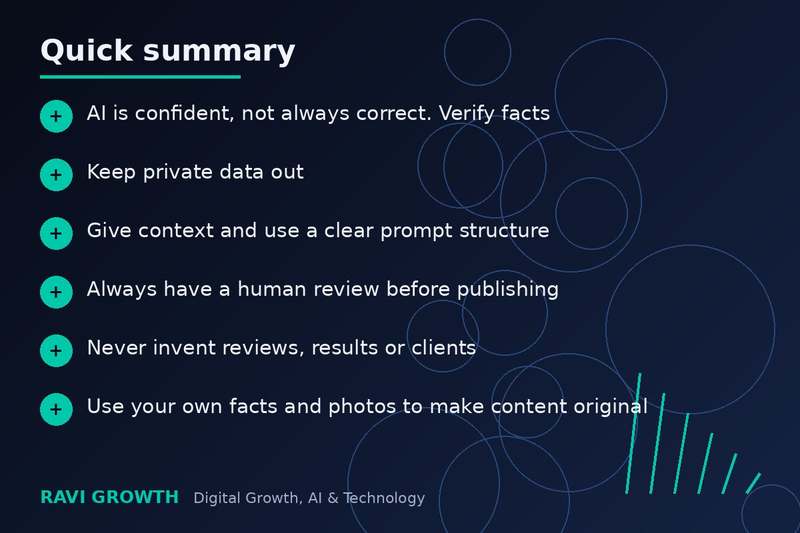
Quick summary
- AI is confident, not always correct. Verify facts.
- Keep private data out.
- Give context and use a clear prompt structure.
- Always have a human review before publishing.
- Never invent reviews, results or clients.
- Use your own facts and photos to make content original.
- Measure whether it actually helps.
Frequently asked questions
Why does ChatGPT make things up? It predicts likely text, not verified truth. When it lacks facts it can fill gaps with plausible but wrong details.
Can I stop it hallucinating? You can reduce it by supplying facts and telling it not to guess, but you cannot remove the risk. Check anything that matters.
Do I have to say content was written with AI? Rules vary by platform and country. Check current policies. Honesty with customers is the safest approach.
Is it risky to use for a small business? Used with review and care, the risk is low and the time savings are real.
Ravi Growth runs a free audit that includes a simple AI-use policy for small teams. Ask for it on the Contact page.