Ravi GrowthGet Started
AI for business
How a Hotel Can Use AI to Get More Direct Bookings
Online travel agencies (OTAs) bring guests, and they take a commission on every booking. For a small hotel, that commission is a large cost. A guest who books direct pays you, and you can look after them better. Winning even a modest share of bookings back changes your margin.
AI does not do this by itself. It helps you do the ordinary work faster: a clearer website, quicker replies, better review answers and simple reports. This guide covers four steps. It uses no invented numbers, since results differ between hotels. Measure your own.
Why guests book on OTAs, and what you can offer instead
Guests use OTAs for comparison, trust and convenience. To win direct bookings you must make direct booking easy and give a reason to choose it.
Reasons that can work, if you can truly deliver them:
- A better rate or an added benefit, such as breakfast, late checkout or an upgrade when available.
- Easier changes and clearer communication.
- Personal service and local knowledge.
Check any rate-parity rules in your OTA contracts before advertising lower direct prices publicly. Offering a benefit rather than a lower public price is often safer. Read your agreements.
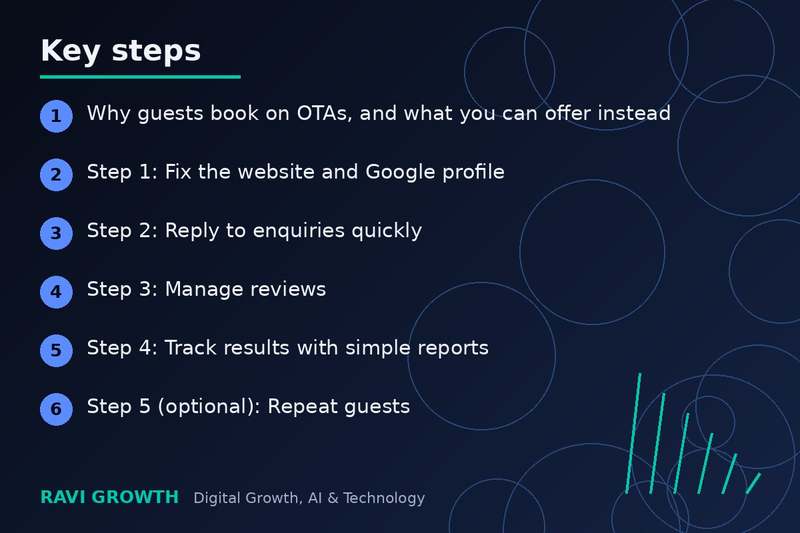
Step 1: Fix the website and Google profile
Most direct bookings start with a search, a map listing or a website visit.
Website
AI can help you draft clearer text. You provide the facts and photos.
- Clear room pages. Size, bed type, view, amenities, photos, who it suits.
- Honest, plain descriptions. Avoid claims you cannot prove.
- A visible booking path. An enquiry form or a booking engine, easy to find on every page, working well on phones.
- Policies in plain words. Check-in times, cancellation, children, pets, payment.
- Location content. How to get there, what is nearby, distances in minutes.
- FAQs with real guest questions.
Prompt: I own a 20-room hotel in [city]. Write a 120-word description for our Deluxe Room. Facts: [size, bed, view, amenities, price range]. Plain words, no hype, do not add facts I did not give. Mark any missing fact as [ADD].
Check every fact before it goes live.
Google Business Profile
For many travellers, the profile is the first view of your hotel.
- Complete every section: category, hours, phone, website, amenities.
- Add real, current photos of rooms, entrance, dining and surroundings.
- Post updates regularly. See our guide on drafting posts and replies.
- Add a booking or enquiry link.
- Keep information the same everywhere.
Step 2: Reply to enquiries quickly
Speed wins bookings. A guest who asks a question and waits a day often books elsewhere.
- Keep a facts sheet: rates, availability process, inclusions, policies, directions.
- Use AI to draft replies from the facts sheet. See our guide on drafting customer replies.
- Reply within a few minutes during staffed hours, and set a clear promise for after-hours replies.
- Always include a clear next step: how to confirm, how to pay a deposit, the date by which the offer holds.
- Make the reply personal: mention their dates, their group and their purpose.
Prompt: A guest asks for a family room for 3 nights from [date], 2 adults and 1 child aged 6. Using only these facts: [facts], draft a warm reply under 90 words with the rate, what is included and how to confirm. If availability is unknown, say we will confirm within the hour.
Never let AI confirm availability or rates by itself. A person checks and sends.
Be careful with automatic chat tools. Poorly configured automation promises rooms you do not have. If you consider an automated assistant for your website, test it on real questions, keep it limited to facts you supply, and make it easy to reach a human.
Step 3: Manage reviews
Reviews on Google and travel sites influence booking decisions.
- Reply to every review, good and bad, in your own voice.
- Thank guests specifically. Mention something from their stay.
- For complaints, acknowledge the issue, say what you changed, and offer to talk offline. Never share guest details in public.
- Ask real guests for reviews, politely, soon after a good stay. Never offer payment for positive reviews, and never write fake ones.
- Use AI to draft replies, then edit.
- Once a month, paste anonymised review text into an AI tool and ask for recurring themes: what guests praise and what they complain about. Fix the repeated complaints. That is better for bookings than any marketing text.
Prompt: From these 30 anonymised guest reviews, list the top praised features and the top complaints with how often each appears. Quote short phrases. Use only the text given.
Step 4: Track results with simple reports
Without numbers, you cannot tell what works.
Track weekly, in a sheet:
- Direct enquiries received, by source (website, phone, Google profile, social, repeat guest).
- Enquiries that became bookings.
- Average reply time.
- Direct vs OTA share of bookings, and the commission cost.
- Review count and average rating.
AI can help summarise the sheet in plain language. See our guide on analysing a spreadsheet. Remove guest personal details first.
Set up Google Analytics and Search Console so you can see how many website visitors send enquiries. See our setup guide.
Step 5 (optional): Repeat guests
Past guests are your cheapest bookings.
- Keep a simple list, with consent, of guests who agreed to hear from you.
- Send a short, useful message once or twice a year: a seasonal offer, a new feature.
- Follow privacy and anti-spam laws in your country. Include a clear way to opt out.
- AI can help draft the message. A person approves it.
Privacy and honesty
- Do not paste guest names, ID details, payment information or booking numbers into AI tools.
- Do not claim awards, rankings or reviews you do not have.
- Follow local laws on guest records and marketing consent.
- Keep a person responsible for every message that goes to a guest.
A four-week plan
- Week 1: Update room pages and the Google profile. Gather real photos.
- Week 2: Build the facts sheet and reply templates. Set a reply-time target.
- Week 3: Start replying to all reviews and track recurring themes.
- Week 4: Set up the weekly tracking sheet and Analytics. Review what you learned.
Mistakes to avoid
- Slow replies.
- Automatic answers about availability or price.
- Fake or incentivised reviews.
- Breaking OTA rate rules by accident. Check contracts.
- Pasting guest personal data into AI tools.
- Not measuring anything.
- A booking path that is hard on a phone.
Quick summary
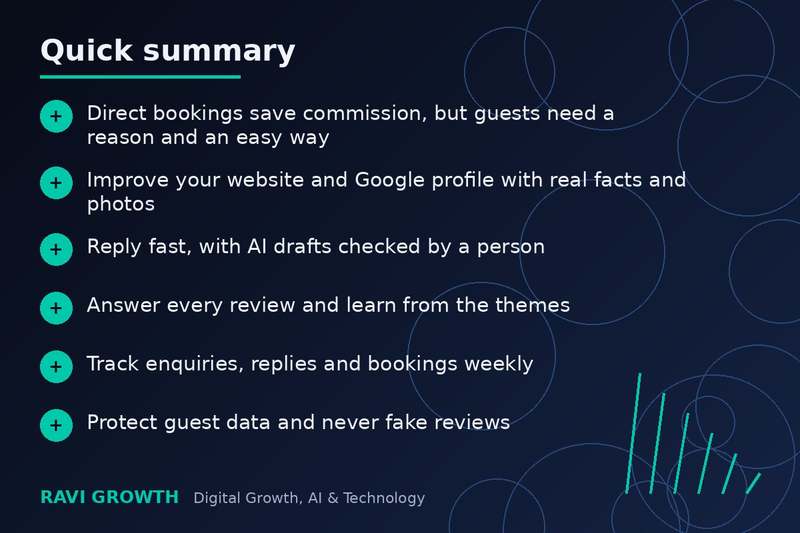
- Direct bookings save commission, but guests need a reason and an easy way.
- Improve your website and Google profile with real facts and photos.
- Reply fast, with AI drafts checked by a person.
- Answer every review and learn from the themes.
- Track enquiries, replies and bookings weekly.
- Protect guest data and never fake reviews.
Frequently asked questions
Will AI replace my front desk? No. It speeds up drafting. Guests still value a real person.
How much will I save? It depends on how many bookings move direct. Track your own numbers.
Can I advertise a lower direct price? Check your OTA agreements first.
Do I need a booking engine? An easy way to book or enquire is needed. Options range from a simple form to a full engine.
Ravi Growth helps hotels build websites, enquiry systems and simple AI-assisted workflows. Ask for the free audit on the Contact page.